Based on the information submitted as shown below:

Room geometry used
- Length (Lx) = 5.00 m (front wall → back wall)
- Width (Ly) = 4.00 m
- Height (Lz) = 2.60 m
- Speed of sound used: c = 343 m/s
- Volume V = 52.0 m³
- Total surface area S = 86.8 m²
1) Lowest room modes (20–200 Hz region)
Mode frequency formula used:
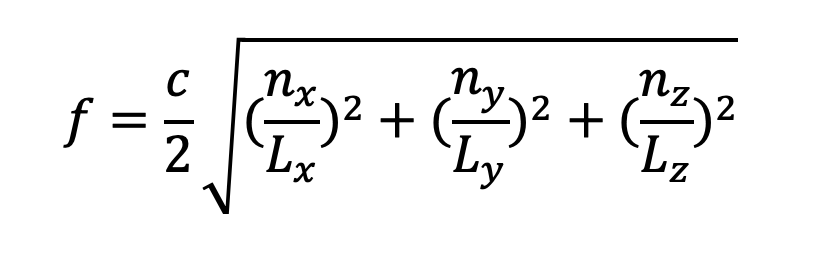
Below are the lowest 12 mode frequencies (indices shown as (nx,ny,nz)):
| Rank | Mode (nx,ny,nz) | Frequency (Hz) |
| 1 | (1,0,0) | 34.30 Hz |
| 2 | (0,1,0) | 42.88 Hz |
| 3 | (1,1,0) | 54.91 Hz |
| 4 | (0,0,1) | 65.96 Hz |
| 5 | (2,0,0) | 68.60 Hz |
| 6 | (1,0,1) | 74.35 Hz |
| 7 | (0,1,1) | 78.67 Hz |
| 8 | (2,1,0) | 80.90 Hz |
| 9 | (0,2,0) | 85.75 Hz |
| 10 | (1,1,1) | 85.82 Hz |
| 11 | (1,2,0) | 92.36 Hz |
| 12 | (2,0,1) | 95.17 Hz |
How to read this:
- The axial modes (like (1,0,0), (0,1,0), (0,0,1)) are usually the strongest. In this room you’ll likely hear a strong build-up around 34 Hz and 43 Hz, plus a cluster of energy in the 65–95 Hz region.
- These frequencies are the ones that are most likely to produce audible peaks (boomy bass) or nulls (missing bass)at specific listening spots.
2) SBIR (Speaker–Boundary Interference Response) — simple numeric example
Key point: for a reflection off the front wall, the path-difference between the direct sound and the front-wall reflection equals 2 × (speaker distance to front wall). A first SBIR null occurs where that path-difference equals λ/2, which gives the simple formula:
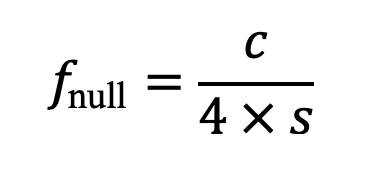
where s is the speaker distance to the front wall.
Example null frequencies for several common speaker front-wall distances:
| Speaker distance from front wall s | SBIR null frequency |
| 0.10 m (10 cm) | 857.5 Hz |
| 0.20 m (20 cm) | 428.8 Hz |
| 0.30 m (30 cm) | 285.8 Hz |
| 0.60 m (60 cm) | 142.9 Hz |
Interpretation:
- If your speakers sit just 30 cm from the front wall, expect a strong SBIR null near 286 Hz (mid-bass / lower midrange).
- If they are 60 cm from the wall, the main null is near 143 Hz (low-mid/upper bass) — which is often more audible and problematic in small rooms.
- You can move the speakers forward/back to shift those nulls to less problematic frequencies, or treat the wall to reduce the reflected energy.
3) Quick RT60 (Sabine) examples — an estimate of reverberation time
Sabine formula: , where
is total absorption (m² sabine).
Using the room surface area S = 86.8 m², here are three illustrative cases using a uniform average absorption coefficient (α):
- Bare (very reflective, α ≈ 0.05)
- A = 86.8 × 0.05 = 4.34 m² sabine
- T₆₀ ≈ 1.93 s — room will sound quite live/boomy (not ideal for critical listening).
- Furnished (typical furniture, carpet, curtains; α ≈ 0.20)
- A = 86.8 × 0.20 = 17.36 m² sabine
- T₆₀ ≈ 0.48 s — quite usable for music and home theater; pleasant balance.
- Treated (substantial absorption, α ≈ 0.40)
- A = 86.8 × 0.40 = 34.72 m² sabine
- T₆₀ ≈ 0.24 s — very dry, good for critical mixing but may feel “dead” for some listening preferences.
4) Practical, actionable mitigation steps (what to try first)
- Sub crawl: place subwoofer (or subs) at multiple candidate locations (corner, mid-wall, near speaker) and measure or listen for smoothest bass. Multiple subs (2+) drastically reduce modal peaks/nulls.
- Seat repositioning: move the listening seat forward/back in increments of 0.3–1.0 m. Often a small shift removes a null. Try not to place the seat exactly on the back wall.
- Speaker forward/back movement: changing speaker front-wall distance s by 10–30 cm moves SBIR nulls substantially (see numeric table above). If possible, experiment forward/back by similar steps.
- Corner bass traps: install thick absorbers (broadband or tuned) in vertical corners and trihedral corners (floor–wall–wall) to reduce modal build-up — target lowest modes (e.g., 34 Hz is axial; thick traps help).
- First-reflection treatment: put absorption (or reflection-control) at first reflection points on side walls & ceiling above the listening position — this cleans imaging and clarity.
- Diffusion at rear: a mix of absorption + diffusion at the rear wall helps preserve liveliness while taming slap/echo.
- Measurement tools: use Room EQ Wizard (REW) + a calibrated microphone (e.g., UMIK-1) to sweep and measure frequency response and impulse response. REW will show you modal peaks, nulls, and RT60 vs frequency.